

Co-Leader Onboarding
We support leaders for the full shared leadership journey
Co-Leadership: A leadership structure where two or more individuals or groups share executive authority and decision-making responsibilities
Onboarding: Moving Into Co-Leadership
Onboarding can begin when your organization and co-leaders are ready to be supported by a structured, research-based onboarding to sustain your co-leaders and create successful ongoing practice.
Co-Leadership Onboarding


Introduction
Welcome to RALR™ Co-Leadership Onboarding! You’ll be introduced to shared leadership concepts, benefits, and best practices for initiating and practicing healthy partnerships; and meet the RALR™ system that will sustain your ongoing practice.
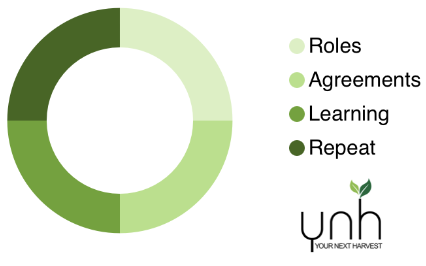
The RALR System
You’ll get a broad overview of the full cycle of shared leadership activities in the RALR™ system that you’ll return to as regular practice to sustain your commitment to the partnership and the organization.
TM


Roles
Focus on clear ROLES as a critical foundation in the partnership, and map your co-leader roles for transparency. We'll introduce the co-leadership liberatory framework, and explore leadership with a traditional and liberatory lens, to observe the distinctive impact each approach offers.

Agreements
Explore the importance and variety, and draft your own upfront AGREEMENTS for shared leadership, including the most critical -- trust contracts for decision making, conflict transformation, and consent.

Learning
Consider how roles create clarity, agreements create accountability, and scheduled LEARNING creates evolution. Create your co-leadership pattern for learning and review to protect shared power over time, and maintain the liberatory framework for your co-leadership practice.

Repeat
Learn how ritualized REPEAT creates the rhythm of practice and ongoing commitment, so shared leadership is not just a staffing structure, but the key to evolution.
✺ Frequently asked questions ✺
-
Co-leadership is not limited to the positional leaders of organizations. In fact, some organizations have found success distributing power and authority within their organization. The RALR™ Co-Leadership Onboarding system can be applied to:
Business CEO’s
Nonprofit executive directors
Organization unit leaders and teams
Collaboratives and task forces
-
Onboarding creates intentionality around trust and transparency, turning assumptions into stated commitments. RALR™ Co-Leadership Onboarding is not a class. It is an immersive experience moving through discussions that help with trust, transparency, and alignment needed to work together and lead your business or community — to make commitments that help build a strong relationship. Waiting to deal with trust, transparency, and alignment issues later when they rise as problems, is what often derails co-leaders. Studies show that co-leaders have a better chance of success when they are supported from the start.
-
A consultant frees you and your co-leader from the facilitator role so you can immerse yourself in the shared leadership journey as a learner, leader, and practitioner.
Studies show that support (consultant, guide) is one of the most important factors in the success of co-leadership. It is also mentioned in hindsight as what co-leaders wish they would have had for their onboarding.
-
RALR™ Co-Leadership Onboarding is not a class. It is a process of co-leaders learning and practicing together the many elements that build trust, transparency, and alignment, with the support of a guide or facilitator, so they can lead the organization together from a strong foundation.
Onboarding will be tailored to the needs and preferences of the co-leaders and organization, with best practices as our guide. Your designed experience will consider:
Readiness assessment
Recruitment and hiring
Timing/duration flexibility
Budget and resources
Layers of support required
-
Your organization decides what timing and depth works best, from short intensive to ongoing support. Examples include:
An accelerated 1-2 week learning intensive
Three months of learning and practice
Six months of learning, practice, structured individual and group coaching
One year of the above followed by on-call coaching and check-ins
-
The cost depends on the level of support, length of time support is needed, and how many co-leaders are part of your group. We can provide estimates and options after learning more in a discovery call.
-
We recommend always starting with an assessment tool for your Board of Directors and decision makers, to help you determine your readiness for adopting a co-leadership model. Self-assessment is a helpful start, whether you do it on your own, or ask us to facilitate assessment for you. We also host a (free) webinar as an introduction to co-leadership.
-
Of course. However, studies show that shared leadership that starts with outside consulting support benefits from a stronger foundation. Partnering with a guide is one determinant of co-leadership success.
-
While (consultant) support can take on many forms for sustaining shared work models at your organization, the following are great starters:
Board and stakeholder education on shared leadership.
Full-cycle consultation and facilitation (education, assessment, recruitment/hiring, onboarding, check-ins).
Executive coaching (1-1 and group) for co-leaders throughout their partnership.
Scheduled learning and review to sustain the practice and maintain flexibility.
-
Yes. We use it in our onboarding because liberatory leadership goes beyond traditional leadership to:
Prevent domination, invisibility, and burnout
Make power visible and leadership humane
Clarify authority, responsibility, and care
Protect dignity under pressure
Address “emotional labor”
Leverage conflict for transformation
Prioritize reflection and repair — key for liberatory leadership
Our liberatory approach also distinguishes our RALR™ Co-Leadership Onboarding system from other traditional consultation.